Shopping condos in Edgewater and keep seeing “01 line” or “03 stack” in listings? You are not alone. In Miami, line numbers are a shorthand that can reveal a unit’s typical views, layout tendencies, and even resale dynamics. In this guide, you will learn exactly what a condo line means, how it maps to orientation in Edgewater, and a simple process to verify the views before you make an offer. Let’s dive in.
What a condo “line” really means
A condo “line” is the vertical stack of units that share the same position on every floor. Think of it as the column that repeats from the 5th floor to the penthouse. Lines are often labeled with two digits like 01, 02, or 03, and in many Miami buildings the unit number combines floor and line. For example, 1501 often means 15th floor, line 01.
There is no universal standard for which line faces which direction. One building’s 01 line could be a southeast corner with bay vistas, while another’s 01 could face the street. The only way to be certain is to pull the floor plate or plan set for that specific building. You can usually get these from listing agents, developer materials, HOA records, or the recorded condominium plan.
How listings use line numbers
- MLS numbers often follow a floor-line pattern, but you should confirm the format with the listing agent.
- Line notes may appear in remarks, such as “01 line is a corner with bay view.” Treat this as a clue, then verify with the floor plate.
- Floor plans and building brochures often show stack diagrams that tie each line to the elevator core and exterior walls.
Where to find line information
- Floor plates and plan sets in developer or HOA documents.
- Recorded condominium plats and offering plans.
- Building or unit brochures that map stacks and typical views.
How lines relate to views in Edgewater
Edgewater sits along Biscayne Bay, with the Miami Beach skyline to the east and Downtown to the south and southeast. That geography sets clear expectations for exposure and light, but each building’s floor plate controls the final outcome.
Typical stack types you will see
- Corner stacks. Often larger footprints with two or more exposures. Corners tend to trade at premiums when they capture bay or skyline views.
- Middle stacks. Usually oriented to one primary direction. Some are mirrored across the elevator bank, so two lines can share the same plan facing opposite sides.
- Through-units. These span from front to back and provide cross-ventilation with multiple exposures. Some Edgewater buildings offer these in select lines.
Edgewater orientations and landmarks
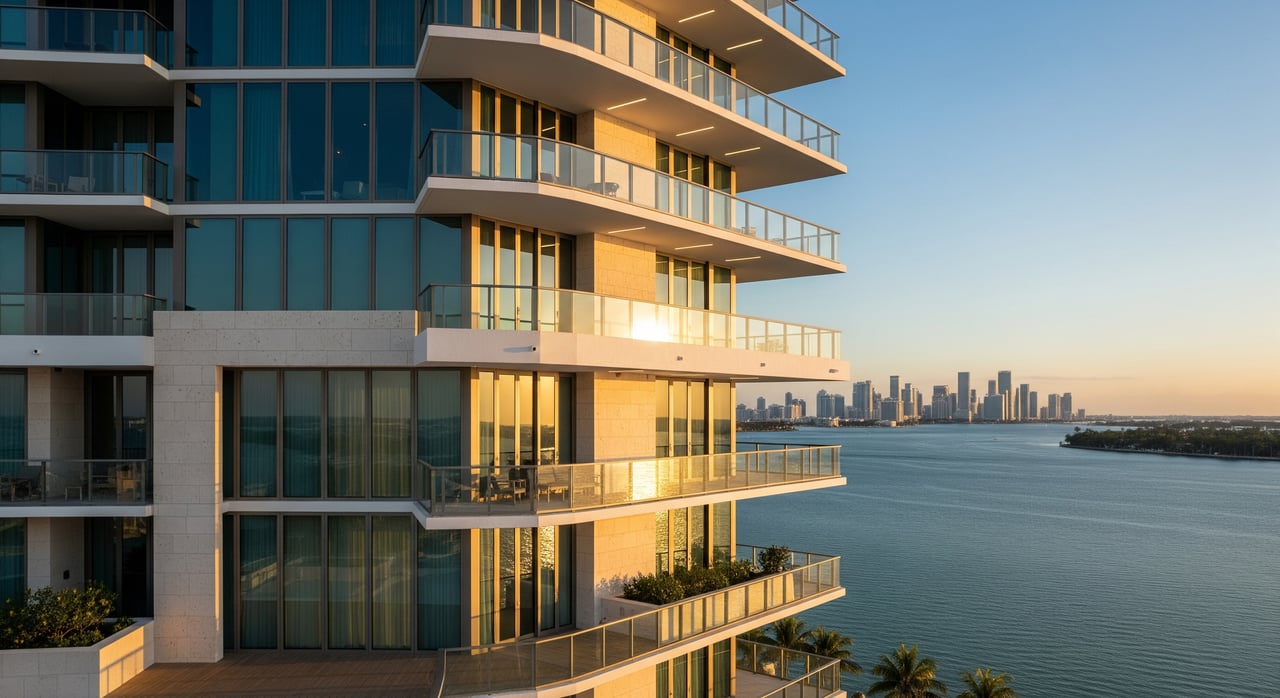
- East or bay-facing. Looks toward Biscayne Bay, the Venetian Islands, and the Miami Beach skyline. These views are highly prized.
- Southeast or Downtown-facing. Often delivers panoramic Downtown and Brickell skyline views, with the Port of Miami in the distance.
- North-facing. Can capture Midtown and Upper Eastside, sometimes with partial bay, depending on the building’s position and neighbors.
- West or street-facing. Usually looks toward the city grid or nearby buildings. This can be the value play for buyers who prioritize layout or price over a water view.
Local infrastructure can shape what you see and hear. The Julia Tuttle Causeway and I-395 sit south to southwest from portions of Edgewater and may influence sightlines and ambient noise depending on the line and floor.
Sun path and daily comfort
- East-facing lines get sunrise light and tend to run cooler in late afternoon.
- West-facing lines can receive stronger afternoon sun and may feel warmer later in the day.
- If you are sensitive to heat load or glare, visit at different times to evaluate comfort and AC needs.
Why a line affects resale value
Lines are more than a numbering system. They often track with consistent view corridors and layouts, which in turn drive pricing and time on market.
Primary drivers of line-based premiums
- View quality. Unobstructed bay or skyline views usually command higher prices and stronger demand.
- Scarcity. If a building offers only two corner line stacks per floor, they can be harder to find and hold value better.
- Layout efficiency. Larger or better-planned lines, including private elevator foyers or strong bedroom separation, tend to outperform.
- Floor level. The same line on a higher floor often achieves better views and can sell at a premium.
- Noise and privacy. Lines near busy streets, mechanical areas, or service corridors may trade at discounts.
- Parking or storage allocations. In some buildings, historical pairings with preferred parking or storage can influence desirability.
Buyer preference patterns in Edgewater
Many Edgewater buyers seek east or southeast orientations for Biscayne Bay and skyline vistas. Corner lines attract attention for their wrap views and light. Value-focused buyers sometimes choose interior or street-facing lines to gain more square footage or a better floor plan for the price.
Caveats to keep in mind
Premiums vary by building and market cycle. In a competitive market, a prime bay-facing line might command a larger spread. In a cooler market, that gap can narrow. New construction, renovations, or future towers can shift view corridors and change a line’s appeal over time, so confirm current and proposed neighboring development.
Step-by-step: decode a listing and floor plate
Use this practical workflow to translate a unit’s line into likely views and resale implications.
- Before you visit
- Confirm numbering. If you see 2301, ask the listing agent to confirm it means 23rd floor, line 01 in that building.
- Request the floor plate. Ask for the plan that shows the elevator core and the numbered stacks for the floor you are considering.
- Map orientation. Pull up a satellite map and align the building footprint with the floor plate so you can match each line to a compass direction.
- Check public filings. The recorded condominium plan or offering plan can validate how units are numbered and how common areas sit relative to the stacks.
- During evaluation
- Verify exposures in person. Take balcony and window photos to confirm the actual view corridor. Note any new construction that could narrow sightlines.
- Visit at different times. Compare morning and afternoon for sun, heat, and noise. East versus west can feel very different in Miami.
- Pull same-line comps. Analyze closed sales in the same building and ideally the same line to understand true pricing by stack and floor.
- Ask about quirks. Some lines share mechanical walls, have different balcony glazing, or experience HVAC or plumbing noise. Confirm these on site.
- When comparing options
- Prioritize layout and usable space. A slightly less dramatic view can still be the better unit if the plan lives better day to day.
- Confirm HOA or maintenance nuances. Larger balconies or different HVAC contributions can affect monthly fees in some lines.
- Define what “corner” means. Some “corner” lines have limited secondary exposures. Ask for diagrams and photos to confirm window lines.
- Study resale history. Reviewing days on market and sale prices by line can reveal liquidity and price resilience.
How to think about floors vs. lines
Within any stack, higher floors often command better views. Yet the relationship is not linear. A mid-level floor in a prime bay-facing line can outperform a higher floor in a street-facing line. Conversely, a lower floor in a corner line may feel more private and offer a better layout than a higher interior line. Pull comps both by line and by floor to see where the value truly sits.
What to watch in Edgewater specifically
- East and southeast lines typically offer the most celebrated views across Biscayne Bay and toward Downtown.
- North-facing lines can be attractive where the stack picks up partial bay or longer view corridors past neighboring towers.
- West-facing lines can be your square-footage value and may deliver city sunsets, but confirm afternoon heat and potential street noise.
- Future development can change view dynamics, so ask for any known projects nearby and verify current sightlines.
Smart questions to ask before you offer
- Which side of the building is the 01 line, and what is its compass orientation on my floor?
- Are the 01 and 02 lines true corners or just plan corners with limited windows?
- Has any nearby development affected views for this line in the past 5 years?
- Do any lines come with historically preferred parking or storage locations?
- Are there known stack-related quirks, like plumbing noise or mechanical closets adjacent to bedrooms?
Make a confident Edgewater choice
When you understand how lines map to orientation and floor plans, you can compare units with far more precision. Verify the floor plate, confirm actual exposures in person, and price by line and floor rather than by square footage alone. This disciplined approach helps you secure the right view, the right layout, and stronger resale potential.
If you want a research-driven partner to source the right line, confirm view corridors, and price by stack-specific comps, connect with Mark Yaffe. You will get boutique, white-glove guidance backed by deep market analysis and global reach.
FAQs
What does a condo “line” mean in Edgewater?
- A line is the vertical stack of same-position units on each floor. It signals likely orientation and layout, which you should verify with the building’s floor plate.
Does the 01 line always have the best view?
- No. Line numbers are building-specific. In some towers 01 is a corner with bay views, in others it faces the street. Always confirm with the floor plate and listing agent.
How do lines affect resale value in Edgewater?
- Lines that deliver direct bay or skyline views, corner exposures, or superior layouts often command premiums and can sell faster, especially on higher floors.
How can I confirm a line’s orientation before touring?
- Request the floor plate, align it with a map to find compass directions, and ask the listing agent which side corresponds to each line. Then verify in person.
Do east-facing lines feel different than west-facing?
- Yes. East-facing stacks get morning sun and tend to run cooler later in the day. West-facing stacks receive stronger afternoon sun and can feel warmer.
Should I prioritize corner lines over middle lines?
- Not by default. Corners can offer multiple exposures and larger plans, but a well-laid-out middle line with a strong view can be the better value.
How much more do bay-facing stacks cost?
- Premiums vary by building and market cycle. Analyze closed sales in the same building and same line whenever possible to gauge an accurate spread.
Where can I find the building’s floor plate?
- Ask the listing agent, the HOA, or check developer documents and recorded condominium plans. These usually show stack numbers and orientation.