Brickell Pre-Construction Strategy For Developers
If you are planning a condo launch in Brickell, the old playbook may not be enough. This is not a market where broad pricing, generic amenities, and a fast public release automatically create momentum. Today, Brickell rewards developers who read demand carefully, build the right unit mix, and position projects for a global buyer pool from day one. Let’s dive in.
Brickell entered 2026 as a selective market with meaningful inventory and slower absorption. In Q1 2026, the existing condo market posted an average sale price of $851,629, an average price per square foot of $666, a median sale price of $590,000, 187 closings, and 19.0 months of absorption.
That followed Q4 2025, when average sale price reached $821,989, average price per square foot was $657, closings totaled 201, and absorption stood at 17.0 months. Active inventory stayed roughly between 1,140 and 1,182 units across those periods, while listing discounts averaged 8% in Q4 2025 and 9% in Q1 2026.
For developers, that matters because Brickell does not currently read like a shortage market. It reads like a market where buyers have choices, compare options carefully, and respond to value, timing, and product clarity more than to aggressive headline pricing.
In an inventory-heavy environment, pricing is strategy. When the resale market is already showing 17 to 19 months of absorption and average discounts near 8% to 9%, overreaching at launch can reduce velocity and create pressure later in the sales cycle.
A more durable approach is to price against current comparables, not future hope. In Brickell, that means using measured price progression, preserving premium inventory for later phases, and avoiding the kind of broad release that can force unnecessary discounting.
Developers who stay disciplined often protect both brand perception and long-term revenue. In a market like this, the goal is not simply to announce a project. It is to control absorption in a way that supports the full capital stack and keeps pricing power intact.
One of the clearest facts in Brickell is the importance of international demand. Miami ranked as the number one U.S. destination for global home buyers, and South Florida’s foreign-buyer share was 15% in 2025, compared with 2% nationally.
New-construction activity shows that trend even more strongly. MIAMI Realtors reported that 49% of new South Florida construction, pre-construction, and condo-conversion sales were purchased by global buyers over the 18-month period ending June 2025, rising to 52% over the 22 months ending November 2025.
Brickell stands out even within that landscape. In Brickell, 60% of new-construction sales were global-buyer sales, and of those international buyers, 79% were Latin American. The same report tracked 1,226 Brickell units sold, including 733 international sales.
This buyer profile shapes launch strategy in practical ways. Florida Realtors’ 2024 survey found that 67% of Florida international buyers paid cash, 69% were non-resident buyers, and 45% of all Florida international buyers came from Latin America and the Caribbean.
For a developer, that points to a buyer pool that is often cash-capable, globally mobile, and responsive to multilingual communication. It also suggests that private previews, polished presentation, and clear transaction guidance are not optional extras. They are part of the sales infrastructure.
Brickell’s location remains one of its strongest selling points. The neighborhood is marketed as being within walking distance of Brickell City Centre, South Miami Avenue dining, the Underline, Metrorail, Metromover, and Brightline, with Miami International Airport about a 15-minute drive away.
That level of connectivity helps explain Brickell’s broad buyer appeal. It can attract local professionals, second-home owners, and international buyers who value ease of movement in and out of Miami.
For developers, this means the location story should be framed around access and convenience, not just skyline views. A project that connects residents to business, dining, transit, and travel can speak to several buyer profiles at once.
Current product in Brickell spans boutique and large-scale formats. The Standard Residences, Brickell offers studios, one-bedroom and two-bedroom homes plus 32 penthouses, with one- to three-bedroom residences starting from $600,000. 2200 Brickell offers one- to four-bedroom residences plus garden villas and starts at $1,000,000.
Cipriani Residences Miami includes one- to four-bedroom homes along with a 74-home Canaletto Collection and six penthouses. The Residences at 1428 Brickell is limited to 195 homes in two- to four-bedroom plus den layouts ranging from 1,800 to 4,000 square feet.
Even with that range, resale trends point to the clearest path for absorption. Two-bedroom homes represented 45.7% of Brickell sales in Q3 2025 and 44.8% in Q4 2025, while one-bedrooms led Q1 2026 at 41.2%.
That supports a layered stack strategy:
This approach gives developers a better chance to match product to actual market behavior. It also helps preserve the value of larger homes, which often carry the strongest branding role in a luxury tower.
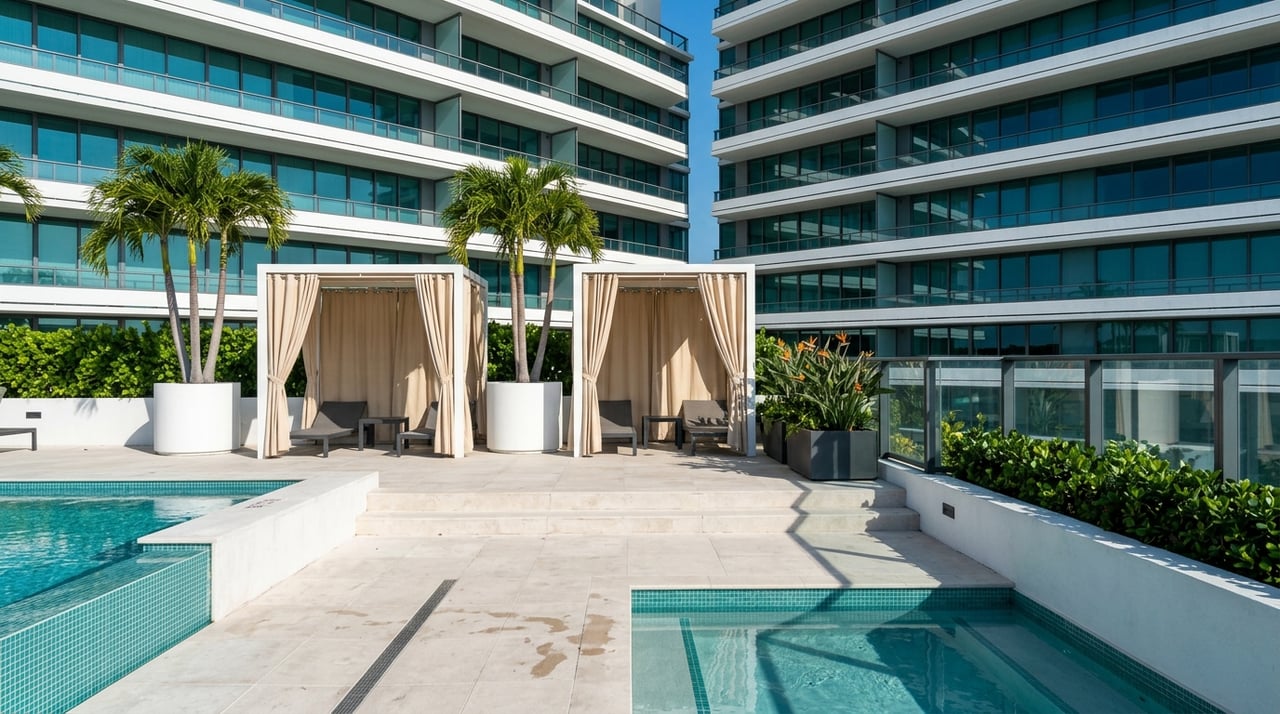
In Brickell, amenity programs are moving beyond a simple pool-and-gym checklist. The strongest new projects are leaning into hospitality-style living, wellness programming, private-club environments, and service layers that support daily use.
At 1428 Brickell, the amenity package includes 80,000 square feet for 195 homes, with features such as a rooftop adults-only pool, wine and spirits lounge, owner’s club, private dining, business lounge, family Imaginarium, gatehouse, 24/7 concierge, and private valet access.
Cipriani Residences Miami adds around-the-clock dining, a cycling-focused wellness center across four levels, holistic spa, private restaurant, children’s playroom, golf simulator, pickleball court, and services like plant care and away-from-home maintenance.
The Standard includes a rooftop pool, speakeasy, bowling alley, screening lounge, wellness spa with hamam and salt room, co-working lounge with private Zoom rooms, multilingual on-site team, and concierge services such as housekeeping and pet care. Meanwhile, 2200 Brickell emphasizes WELL certification, work-from-home suites, EV charging, automated parcel storage, cycling lounge, wellness lounge, rooftop outdoor fitness, yoga, spa, pickleball, and children’s spaces.
The takeaway is simple: amenity marketing in Brickell now centers on lifestyle infrastructure. Buyers are not only comparing finishes and views. They are comparing how well a building supports work, travel, wellness, privacy, and service.
Because new-construction sales are often not fully reported in MLS, Brickell’s launch environment depends heavily on curated distribution and relationship networks. MIAMI’s June 2025 new-construction report itself was built through collaboration with several major market participants, which highlights how important off-MLS intelligence remains in this segment.
For developers, that means broker relationships, private previews, and data-sharing partnerships should be built into the launch plan early. Waiting to activate those channels after public marketing begins can reduce early momentum.
A phased release is especially important in today’s market. With marketing times in the resale market running roughly 113 to 125 days and absorption elevated, it is often smarter to release stacks gradually, study buyer response, and then move pricing step by step.
That kind of measured rollout does two things well. First, it protects the perception of scarcity. Second, it gives the sales team room to refine message, product emphasis, and pricing based on actual traction.
Given Brickell’s international buyer base, multilingual execution should be considered core operating strategy. English and Spanish are especially important, but the larger point is clarity, responsiveness, and confidence for cross-border buyers.
That includes launch materials that explain deposit schedules clearly, a process that supports foreign-funds documentation, and a sales team that is ready for cash-heavy transactions. In Brickell, this is not a niche concern. It is central to the way a project reaches a large share of its likely buyers.
For a brand like Mark Yaffe, this is where boutique service and global reach can work together. A developer does not only need exposure. You need refined positioning, strong buyer qualification, and a team that understands how to communicate with international clients at a high level.
The strongest Brickell pre-construction strategy today is balanced, not flashy. It treats the project as both a real estate launch and a capital-markets exercise, while still recognizing that luxury buyers care deeply about lifestyle, service, and brand identity.
In practice, that means a defensible strategy often includes:
Developers who align product, pricing, and sales execution around these realities are better positioned to protect value and maintain momentum. In Brickell, precision tends to outperform noise.
If you are evaluating a Brickell launch, repricing a development, or refining a go-to-market plan for premium inventory, working with an advisor who understands both market data and luxury buyer behavior can make a meaningful difference. Mark Yaffe offers a discreet, research-driven approach to developer representation, new-development positioning, and cross-border luxury sales in Miami.
Stay up to date on the latest real estate trends.
Guiding Mark's clients step-by-step through a landmark, emotional financial transaction and easing the process by finding them the best deals, is what Mark does best for his local and international clientele. Mark leverages his knowledge of the Miami Real Estate market and relationships with brokers, developers, attorneys, and investors in order to do so.