The Venetian Causeway's Big Repair Hasn't Started. The Quiet One Just Wrapped.
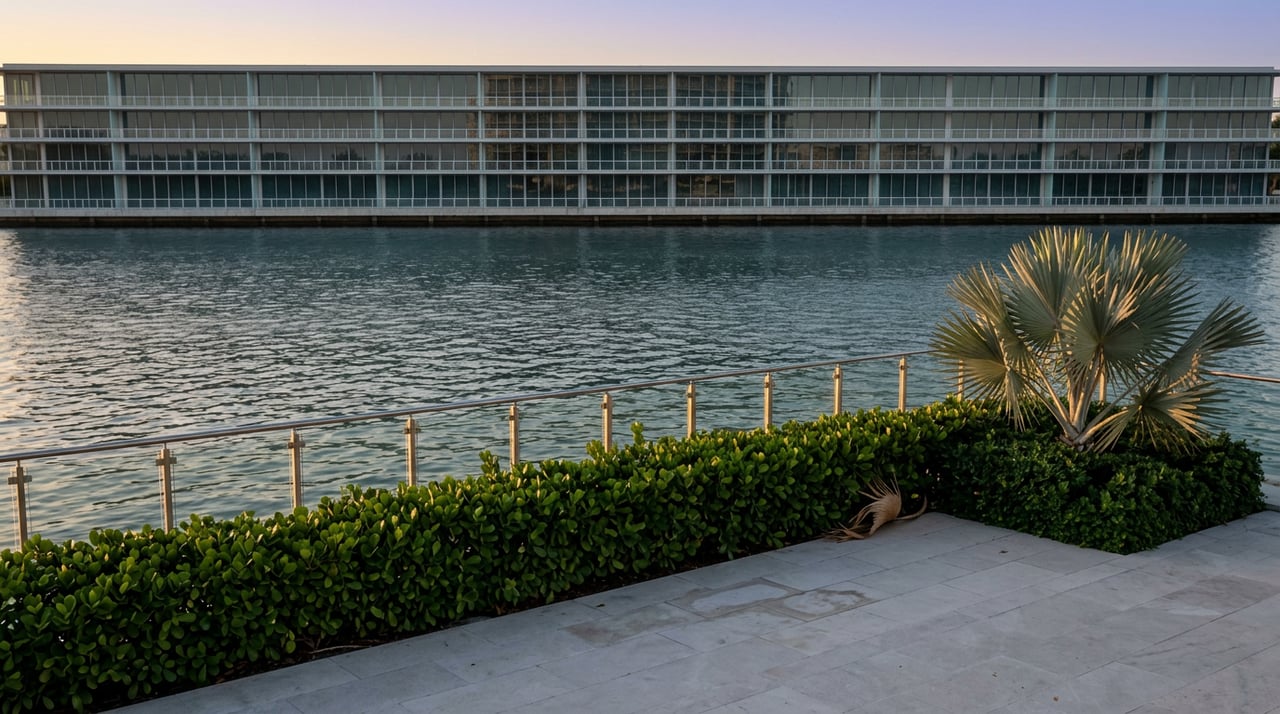
Which Venetian Causeway project was supposed to wrap by late summer?
If you guessed the bridges, you guessed wrong. The project everyone on the islands has been bracing for, the one with the $100.5 million federal grant attached to it, hasn't touched a single beam. The work that has actually been running underground and mostly out of sight, the water and sewer main replacement, was supposed to wrap by the time Labor Day traffic thinned out. Two projects, two very different clocks, and most of the confusion on the islands comes from mixing them up.
The City of Miami Beach's Venetian Causeway Water and Sewer Main Upgrades Phase II replaces the aerial water main crossings that run along the north and south sides of the Venetian bridges. These aren't cosmetic pipes. The city's own Water & Sewer Renewal and Replacement Report ranked them first on its list of critical assets, meaning the causeway's water lines were judged to be in worse shape than any other infrastructure the city was tracking. The contractor is Quality Enterprises USA, with Hazen & Sawyer and Calvin, Giordano & Associates handling design.
The city's published timeline called for substantial completion in late spring to early summer, with final completion by late summer 2026. In Miami Beach planning language, that puts the finish line somewhere around Labor Day. If your stretch of the causeway is still fenced off this month, the project has slipped past its own schedule, not started late.
That distinction matters for anyone timing an evening walk over the bridges or a bike ride toward Purdy Avenue. The disruption from horizontal directional drilling, the trenchless method the city used to install the new lines with minimal surface digging, was supposed to be a spring and early summer problem. By this point in September, it should be a memory, not a detour.
The bigger project is the one people actually talk about at dinner: eleven of the causeway's twelve bridges getting replaced, funded by a $100.5 million grant from the federal Bridge Investment Program. Congresswoman Frederica Wilson secured the award and Miami-Dade's transportation department has been moving it through design ever since.
Here's the number that puts the urgency in context. The current arch bridges date to the mid-1920s and were built with a fifty-year design life. That means the spans residents cross every day are now roughly a century old, about double what they were engineered to last. The replacement bridges are designed for another 75 years and will be 16 feet wider, which matters most to anyone who bikes the causeway: the current cross-section is narrow enough that cyclists get pushed into the travel lane on a corridor that already carries around 1,500 riders a day.
None of that construction has started. The federal government's own permitting dashboard lists the estimated completion date for environmental review and permitting at October 30, 2026. Design finishes this summer, review clears in late October, and only then does the project go out to bid. As Eulois Cleckley, director of Miami-Dade's Department of Transportation and Public Works, put it when the grant was announced, "We are excited to move this project forward and make the Venetian Causeway safer and better connected for all users." Excitement is appropriate. So is patience. Bid documents are not backhoes.
Here's how the two projects actually compare on the calendar:
| Water & Sewer Main Upgrade | Bridge Replacement | |
|---|---|---|
| Funded by | City of Miami Beach capital program | $100.5M federal Bridge Investment Program grant |
| Scheduled completion | Late summer 2026 | Construction not yet advertised |
| Status as of September 2026 | Should be finished or close to it | Environmental review open through October 30, 2026 |
| What it means day to day | Minor closures winding down | No beams touched yet, no timeline for when they will be |
While the county and the city work through permits and pipe schedules, the block you land on when you come off the eastern end of the causeway has quietly turned over its tenant list. Sunset Harbour saw several high-profile closures this year, including Panther Coffee, Stiltsville, and Sardinia.
What actually leased into those vacancies tells a different story than the closures did. Three moves worth knowing about:
Miami New Times framed the BeyBey reopening as a bet on Sunset Harbour as a local-first destination rather than a tourist stop. A closed coffee shop and a shuttered Mediterranean restaurant left a gap. Among the new offerings, BeyBey has added lunch service and an honor bar, with a newly approved permit for a cocktail bar.
If you live on the islands, the practical read is simple. The disruption you've been working around all summer, the fenced sections and the drilling noise, was tied to pipes that were supposed to be done by now. Check your stretch before assuming it's still on schedule. The disruption you haven't seen yet, the one with sixteen extra feet of bridge deck and separated bike lanes, is still sitting in a review queue that doesn't clear until the end of October, and construction won't start the day after that either. Bid packages take time to write and award.
Meanwhile, the place you actually walk to for dinner has changed more in the last few months than the roads have. If Sardinia and Panther Coffee were part of your old rotation, Sunset Harbour is worth a slow lap again before the year is out.
If you're weighing what any of this means for a home on the Venetian Islands, whether you're already here or thinking about the value a fully modernized causeway and a resettled Sunset Harbour dining scene adds over the next few years, Mark Yaffe tracks these shifts as part of the daily work of understanding this market, not as an afterthought. Work With Mark for a read on what infrastructure timelines like this one actually mean for your property, not just your commute.
Stay up to date on the latest real estate trends.
Guiding Mark's clients step-by-step through a landmark, emotional financial transaction and easing the process by finding them the best deals, is what Mark does best for his local and international clientele. Mark leverages his knowledge of the Miami Real Estate market and relationships with brokers, developers, attorneys, and investors in order to do so.