In Coconut Grove, Every New Condo Starts as a Building Someone Already Owns
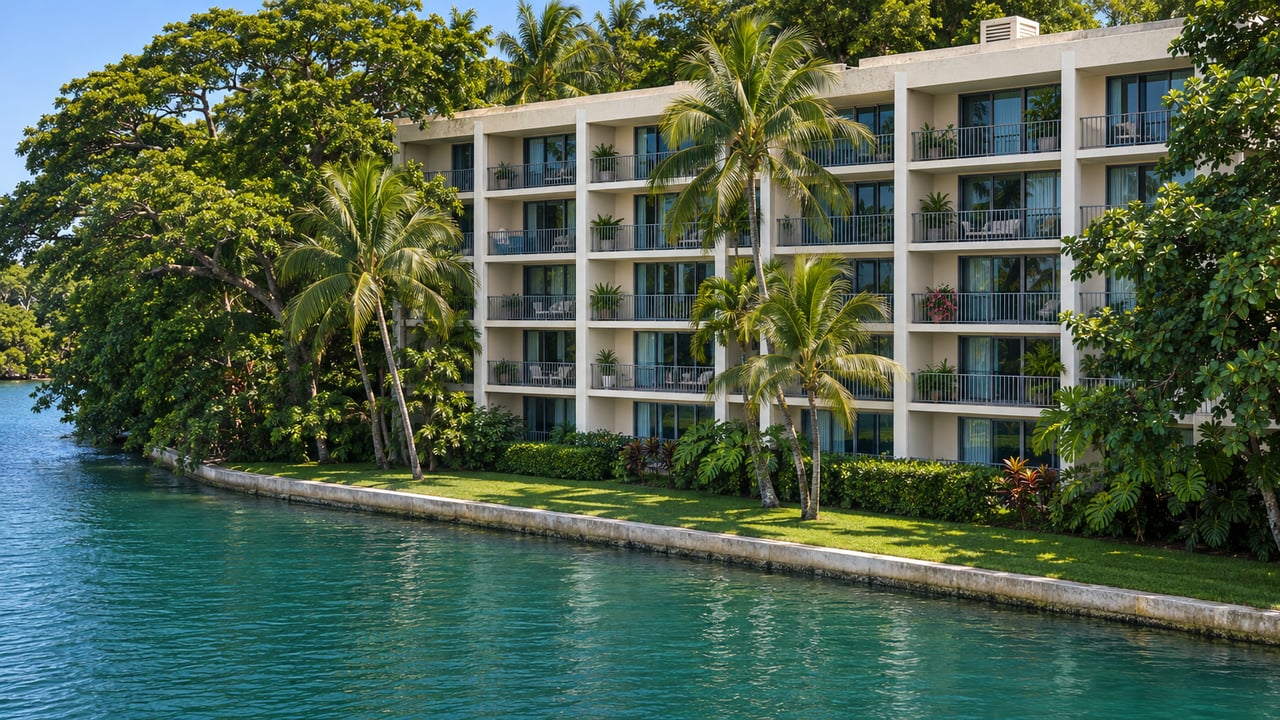
How much does a repair estimate weigh in a $160 million offer? At the Mutiny on South Bayshore Drive this summer, it may have decided the outcome. BH Group's bid to buy the 1968 building expired in August without the 80% owner approval Florida law requires. Coconut Grove Spotlight reported that the buyer's side had expected owners to face a roughly $30 million special assessment. Then the condo board shared a much smaller figure.
This matters to anyone buying in Coconut Grove because it shows where the neighborhood's next luxury homes come from. Very little new Grove inventory goes up on empty land. It goes up where an older condo, office building or hotel stood, after someone has agreed to sell. The price of a new Grove residence is largely set in that first deal. The terms of the older building's deal are also what decide whether the new project happens at all.
The Mutiny was the Grove's first high-rise. It is a 12-story condo-hotel at 2951 South Bayshore Drive, and BH Group offered its 170 residences a combined $160 million. It was the third attempt in less than two years to buy out the owners, after earlier offers from DaGrosa Capital and Slate Property Group.
Greg Greer, the sales agent representing the buyer, told the Spotlight that BH Group had been told to expect a special assessment of about $30 million for the nearly 60-year-old building. A bill that large would have made a cash offer look better to owners. The Spotlight also reported that the association's president said the figure never came from the building. Owners were relieved when the board released a much lower assessment, which one owner said covered mostly minor exterior work such as painting and resealing doors and windows.
Greer explained to the Spotlight why the developer stepped back:
"The offer that we made was more than what the land was really worth for us in today's market."
A buyout price is weighed against what owners expect it will cost them to stay, and here the expected cost of staying fell before the deadline. Greer said the smaller assessment was part of why the offer stalled. As of the Spotlight's August report, BH Group was "sitting on the sidelines" and would revisit the deal if owners became interested in selling.
The Grove has few ways to grow taller. In June 2025 the City of Miami closed a bonus-height loophole and restored Coconut Grove's exemption from transit-linked bonus rules. The WELL was allowed to keep its vested eight-story allowance. A month later, commissioners approved a citywide transit-area zoning overhaul. The Spotlight reported that revisions to it excluded Neighborhood Conservation Districts, including Coconut Grove.
With height limited, a developer's math depends on adding units to a site that already holds a building. Spencer Morris of Allen Morris Company, the developer of Ziggurat on Grand Avenue, told the Spotlight that land values in the Grove have passed the value of some older condo buildings on that land. He added that rebuilding a two-story building as another two-story building would not make economic sense. To make the numbers work, a site has to be "dramatically" densified.
The Grove's buildings are also small, which makes them easier to buy out. In the same article, analyst Peter Zalewski put the average unit count of the Grove's older buildings at around 17. Fewer owners means fewer people who have to agree. Florida's post-Surfside reforms raised reserve requirements and required more frequent structural studies. The Spotlight reported that for some associations, a buyout has become a way out of that financial pressure.
| Address | What stood there | What is planned or happening |
|---|---|---|
| 2545 S. Bayshore Dr. | Bayshore Park, built 1964, three stories, 39 units | Raffles Residences Coconut Grove, 35 units priced from $4.5 million |
| 2699 S. Bayshore Dr. | Offices in the Grove, a nine-story office building from 1972 | Four Seasons Private Residences, 20 stories, 70 residences |
| Tigertail Avenue | A former five-story Residence Inn | The WELL by Terra, 194 residences over eight stories |
| 3265 Virginia St. | Chateau Grove, built 1963, 25 units | Sold to El-Ad National Properties for $45.5 million in April 2026 |
| 3245 Virginia St. | Virginia Pointe, built 1966, 66 units | 59 units bought by Canero Group and 8K Capital for $27.7 million |
| 2951 S. Bayshore Dr. | The Mutiny, built 1968, 12 stories | Owners kept the building after BH Group's $160 million bid expired in August 2026 |
Every row in the table started with a building already standing on the site. The new projects are branded, hold relatively few units, and are priced in the millions. Each of those traits is a way to carry the cost of buying out the previous owners.
Bayshore Park shows the math most clearly. Mast Capital and BH Group paid $28 million to buy out its 39 owners, which works out to roughly $718,000 per unit. The replacement, Raffles Residences Coconut Grove, will have 35 residences from two to four and a half bedrooms, plus four penthouses, designed by Brandon Haw Architecture. Prices start at $4.5 million. Accor's announcement calls it the brand's first standalone residential project and said sales were expected to launch this fall.
The site now holds four fewer homes than before. Each one is priced from more than six times what the developers paid per old unit. Construction and branding account for part of that gap. Land that once held 39 modest units now carries 35 that must cover the buyout, a full tower build and a hotel brand.
Chateau Grove shows how fast these sites change hands. Canero Group paid $17.3 million in 2025 to buy out the two-story, 25-unit building. In April, El-Ad National Properties paid $45.5 million for it, which the Spotlight described as nearly three times the earlier price. Under its T4-L zoning, the site allows a three-story building. Morris noted that a developer could go taller through City of Miami incentives or the state's Live Local Act.
That is why the Live Local Act matters for Grove land prices. In June the City Commission directed the City Attorney to explore legal options against the law. On November 3, state Sen. Alexis Calatayud, one of the law's authors, won reelection by 1,576 votes. How much a site could eventually hold under these rules is a big part of what a buyer of an older building is paying for.
Owning a unit in one of the Grove's older buildings includes a vote on whether the building is sold. Under Section 718.117 of the Florida Statutes, a residential association needs approval from at least 80% of total voting interests before it can submit an optional termination plan to the state. If 5% or more reject the plan, it cannot proceed, and no new plan can be considered for 24 months.
In a 25- or 39-unit building, that 5% is just one or two owners. Every assessment estimate, reserve study and board communication can affect how those few owners vote. At the Mutiny, the buyer's agent counted the smaller assessment figure among the reasons the offer stalled. In a smaller building, a single owner's decision could settle it.
This is general information about how these rules and deals work, not legal, tax or financial advice. Anyone weighing a purchase in an older association should confirm their own situation with a qualified attorney or advisor.
Buyers of new Grove construction mostly sign for homes with delivery targets in 2028, roughly a year and a half to two years out. Four Seasons Private Residences, from CMC Group and Fort Partners, went vertical in July on a $323.8 million Bank OZK construction loan. Residences run about 2,025 to 3,975 square feet, the penthouses reach about 9,690 square feet, and the project reports more than half presold with a mid-2028 target. Terra and AB Asset Management's WELL is priced from $1.5 million. It secured a $410 million loan, reported more than half sold and is targeting the end of 2028, according to Bisnow. The Lincoln, at 2650 Lincoln Avenue, has 48 residences, a $58 million loan, more than 40% sold and a scheduled completion in Q3 2028.
Arbor Residences at 3034 Oak Avenue shows how far a target date can slip. Its former owners had expected completion in 2019. The project received a temporary certificate of occupancy in March 2026, at which point it was more than 70% presold.
Does a buyout offer mean an older building will be redeveloped? No. The Mutiny received three offers in under two years, and its owners still hold the building.
Why are Grove buildings targeted more often than larger towers elsewhere? Zalewski told the Spotlight that the small unit counts of the Grove's older buildings make it easier to get the required number of owners to agree.
Which document affects a buyout most directly? At the Mutiny, it was the special assessment figure the board shared with owners. A lower number reduced the financial pressure on owners and, according to the buyer's agent, made the offer less attractive.
In Coconut Grove, the cost of a new condo goes back to a buyout deal or an owner vote, and the asking price alone does not show it. If you are considering a Raffles allocation, a Four Seasons residence or a unit in one of the Grove's 1960s buildings, Mark Yaffe can go through the site's history, the association's assessment record and the delivery timeline with you before you commit. Work With Mark.
Stay up to date on the latest real estate trends.
Guiding Mark's clients step-by-step through a landmark, emotional financial transaction and easing the process by finding them the best deals, is what Mark does best for his local and international clientele. Mark leverages his knowledge of the Miami Real Estate market and relationships with brokers, developers, attorneys, and investors in order to do so.